Food for Thought: Idioms from the Kitchen Counter
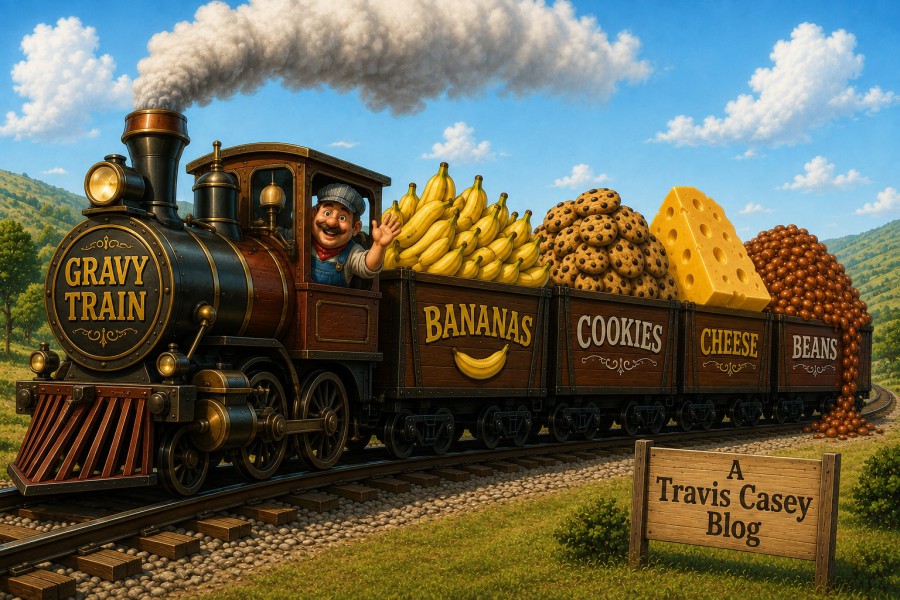
English has a strange habit of turning food into personality, authority, effort, gossip, insanity, and suspiciously easy money. Maybe that is because food is universal. Everybody understands bread, cheese, cake, cookies, beans, bananas, and gravy. Even if you do not know where a phrase came from, you can usually feel what it means. A tough cookie is not going to crumble. A big cheese is important. A piece of cake sounds easy enough to eat without stretching first.
Tough cookie describes someone resilient, determined, and not easily defeated. The image is simple: some cookies are soft, warm, and emotionally available; others could survive a fall from a second-story window and still chip your tooth. Somewhere along the way, English looked at a stubborn biscuit and said, “That’s Aunt Carol.” The phrase seems to have grown in American English as a casual way to praise grit, especially in someone who keeps going after life has tried to dunk them in milk.
Then there is the big cheese, meaning an important person, the boss, the person with the corner office, the parking spot, and the mysterious ability to make everyone nervous by simply clearing his throat. The exact origin is debated, but one popular path links it to the Persian and Urdu word chiz, meaning “thing,” which British speakers in India used in phrases like “the real chiz,” or the real thing. Over time, English may have cheesed it up into “big cheese,” because apparently calling someone “the big thing” was not a label you wanted to put on someone who held power over you.
A task that is easy is a piece of cake, which makes sense if you are the person eating the cake and not the person baking it, frosting it, transporting it, and watching a toddler sneeze near it. The phrase likely grew from earlier uses of cake as a symbol of something pleasant or easily won. “Cakewalk,” for instance, referred to a 19th-century dance contest where the prize was cake, and later came to mean something easy. Eventually, English cut a slice and handed us “piece of cake.”
To spill the beans means to reveal a secret, usually the one thing everyone agreed not to mention until somebody had two glasses of wine and a microphone. One theory traces it to ancient voting practices, where beans or pebbles were dropped into containers to record yes-or-no decisions. If the container tipped over and the beans spilled, the secret result was out.
Go bananas means to become wildly excited, irrational, or unhinged in a way that suggests the zoo gate has been left open. The phrase likely comes from the comic association between bananas and monkeys, because humans never miss a chance to explain their own behavior by blaming animals. If someone goes bananas at a sale, during a football game, or while trying to assemble flat pack furniture without instructions, we know exactly what happened.
Finally, the gravy train is an easy source of money or advantage, especially one that keeps rolling along with very little effort. Gravy has long meant something extra—the bonus flavor on top of the meat and potatoes. So a gravy train is not just income; it is income with comfort, convenience, and possibly a suspicious lack of hard work. It is the dream arrangement: all aboard, no heavy lifting, and someone else bought the ticket.
That may be why food idioms stick. They are vivid, funny, and instantly understood. We may not know the full history every time, but we know what it feels like to meet a tough cookie, answer to a big cheese, finish a piece of cake, spill the beans, go bananas, or watch someone ride the gravy train while the rest of us are still washing dishes.


 Print
Print 